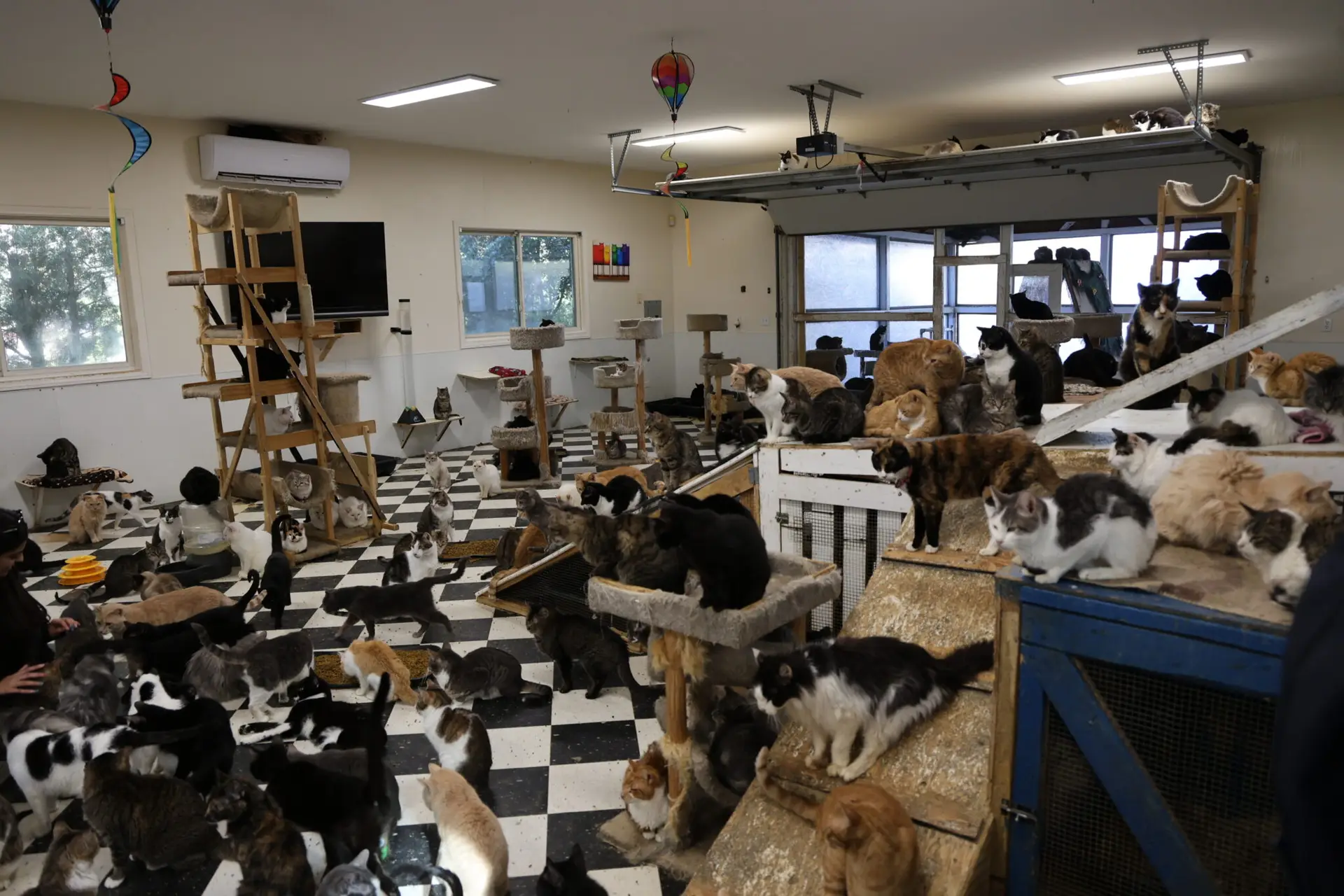
When San Diego Humane Society took custody of hundreds of animals from Villa Chardonnay Horses With Wings in Julian, the public saw images of one of the largest animal-rescue operations in the agency’s history.
But federal bankruptcy records show the May 1 seizure did not begin as a sudden, isolated welfare call.
It followed months of bankruptcy proceedings, millions in debt, a delinquent charitable registration, disputed secured claims against the property, an unpaid multimillion-dollar judgment, court concern over hundreds of animals listed as estate assets, and a trustee’s emergency motion stating that recent inspections and veterinary examinations had revealed “significant care deficiencies” involving several animals.
By the time SDHS arrived at horse sanctuary, Villa Chardonnay was no longer simply a nonprofit animal sanctuary under founder control. It was a Chapter 11 bankruptcy estate, overseen by a court-appointed trustee, with hundreds of living animals treated as property of that estate.
A sanctuary with hundreds of vulnerable animals — and almost no cash
Villa Chardonnay filed its current Chapter 11 bankruptcy case on Oct. 14, 2025, after a prior Chapter 11 case filed in September had been dismissed. In its bankruptcy schedules, the nonprofit listed real property valued at $3.625 million and personal property of just $885.14. Total liabilities were listed at more than $7.4 million.
The filing also listed hundreds of animals. The schedules described categories including 300 horses as “sick and elderly,” 300 cats as “sick and elderly,” along with donkeys, goats, alpacas, pigs, poultry, peacocks, turkeys, turtles, a blind bull and a lamb. Their value was listed as “unknown.”
The bankruptcy court later noted the debtor had listed 673 animals in its schedules and that the sanctuary spanned more than 40 acres.
The same filing reported substantial revenue in the years immediately before bankruptcy: $1.3 million from Jan. 1, 2025 to the filing date, $2 million in 2024, and $1,949,300 in 2023.
Together, the records show a nonprofit with major annual revenue, significant real estate, hundreds of dependent animals, millions in liabilities, and less than $900 in cash on hand at the time of filing. Tax filings show a cost that breaks down to roughly $72,000 a month to feed, provide veterinary care, and farrier services for the animals at the sanctuary.
The Julian property and the debt stack
The Julian property became central to the bankruptcy. Villa Chardonnay’s schedules list the Villa Chardonnay Horse Sanctuary as fee-simple real property valued at $3.625 million using a certified appraisal.
Public real estate listings show the property sold in March 2020 for $2.35 million. Bankruptcy schedules list several disputed secured claims tied to the same horse-sanctuary collateral, including a claim by Investors Mortgage Lending Group, Inc. for $1,695,242.79, with the debt date listed as March 16, 2020. Other disputed secured entries tied to the property include Private Mortgage Lending, LLC and River Falls, LLC, with unknown claim amounts, also dated March 16, 2020.
The schedules also list a disputed Small Business Administration / COVID EIDL Service Center claim of $2,139,920, with the horse sanctuary listed as collateral and a debt-incurred date of Jan. 15, 2022.
That means the equity picture is not as simple as one mortgage and one judgment. The bankruptcy schedules list more than $6.6 million in secured claims against property valued at $3.625 million. Some claims are marked disputed, and some amounts are unknown, leaving the actual lien priority and allowed secured amounts to be resolved through the bankruptcy process.
From animal-placement dispute to multimillion-dollar judgment
One of Villa Chardonnay’s largest creditors is The Ark Watch Foundation and Celine Myers.
Ark Watch’s bankruptcy complaint states that between 2016 and 2018, Ark Watch transferred eight donkeys and two horses to Villa Chardonnay under written “Terms of Transfer.” According to Ark Watch, those contracts allowed Ark Watch to repossess the animals if they were not kept in safe conditions, continued medical care, and required regular vaccines.
The dispute escalated. Ark Watch alleged that one horse died due to Villa Chardonnay’s neglect, that Villa Chardonnay refused to return surviving equines, and that a 2022 judgment ordered the return of nine equines. Ark Watch further alleged that when sheriff’s deputies arrived to enforce the judgment, a Villa Chardonnay representative claimed the equines were in Mexico, while eight donkeys were visible from the street.
Separate from the animal-return dispute, Ark Watch and Myers obtained a defamation judgment against Villa Chardonnay. In bankruptcy filings, Ark Watch said the San Diego Superior Court awarded more than $2 million in May 2024, including $1.5 million in presumed damages, $500,000 in punitive damages, and costs. Ark Watch later filed an adversary proceeding seeking to prevent discharge of the judgment debt, which it listed at $2,289,774.43.
Ark Watch also stated it recorded an abstract of judgment against Villa Chardonnay’s property in June 2024.
That places Ark Watch in a hybrid position: a judgment creditor with a recorded lien against the property, but one whose recovery depends on lien priority, the validity and amount of senior secured claims, sale costs, trustee expenses and available equity.
Charity registration problems brought in the Attorney General
The California Attorney General’s Registry of Charities and Fundraisers also became involved.
In a February 2026 stipulated order, the Attorney General’s office stated that Villa Chardonnay’s charitable registration was delinquent and not in good standing. The order said the debtor could not operate or solicit for charitable purposes in California while its registration was not in good standing.
The order placed Villa Chardonnay on probationary registration, requiring prospective compliance with California charitable-solicitation and nonprofit laws, delinquency cures where reasonably possible, required filings, and payment of fees.
The Attorney General’s office said it entered the agreement to enable the Chapter 11 trustee’s appointment and to facilitate compliance with California law and “proper care of animals housed at the Debtor’s real property.”
That language matters. Months before the SDHS seizure, state charity regulators and the bankruptcy trustee were already treating Villa Chardonnay as a troubled charitable estate with unresolved compliance problems and animal-care implications.
Founders remained on nonprofit property without a written lease, trustee alleged
On April 6, the trustee filed an adversary complaint against Monika Kerber Perez and Mercedes Flores seeking turnover of the Julian real property.
The trustee alleged Villa Chardonnay owned the Boulder Creek Road property, that the property was used to house approximately 600 rescued animals, and that Kerber Perez and Flores resided in structures located on the property. The complaint further alleged that Kerber Perez told the trustee they did not have a written lease with the nonprofit, and that they had not paid rent to the debtor, trustee or estate.
The trustee sought an order requiring removal of all remaining animals and turnover of the property by April 30, 2026, so the property could be sold for the benefit of the estate and creditors.
Those allegations raise a separate governance question: how a nonprofit-owned sanctuary property was being used, whether founder or insider occupancy was approved, documented, reported or compensated, and whether any personal benefit was properly disclosed.
Animal-care concerns escalated before SDHS took custody
The record also shows an evolution in the trustee’s view of the animal-care situation.
In a March 2 response to the trustee’s status report, Ark Watch said the trustee had reported she had “not observed any evidence of animal cruelty or abuse” and that allegations were primarily centered on Villa Chardonnay’s refusal to euthanize animals. Ark Watch pushed back, arguing that its concerns were broader and included vaccination failures, alleged failure to provide proper veterinary care, alleged falsified records, financial shortfalls and prior animal-control reports.
Later that month, on March 26, the trustee filed a declaration saying one day of veterinary examinations offered by Humane Farming Association would not be enough. The trustee asked for authority to use multiple veterinary teams and potentially multiple visits to examine farmed animals, horses and cats at no cost to the estate.
By May 1, the trustee’s position had changed significantly.
In an emergency motion filed that morning, the trustee said two SDHS inspections had occurred, multiple veterinarians had been dispatched, and that the most recent SDHS inspection on April 27 and veterinary examination on April 23 revealed what appeared to be “significant care deficiencies” involving several animals. The trustee said those deficiencies were communicated to Kerber, who assured the trustee they would be addressed, but the trustee was still awaiting veterinary examination results that purportedly addressed the concerns.
The trustee said SDHS notified her on April 28 that it intended to obtain a search warrant to seize all animals immediately. The motion stated the warrant had since issued.
The May 1 turnover was both a bankruptcy order and a warrant-based seizure
The May 1 emergency motion makes clear that the animal transfer was not merely an administrative handoff connected to foreclosure or bankruptcy property sale.
The trustee cited California Penal Code § 597.1, which allows officers, humane society officers or animal control officers to immediately seize animals when prompt action is required to protect animal health or safety. The trustee argued SDHS had statutory authority to seize the animals and that the seizure fell within exceptions to the bankruptcy automatic stay.
The motion also stated that SDHS had informed the trustee that the warrant was part of a criminal investigation involving Villa Chardonnay’s principals.
“As set forth above,” the trustee wrote, “the Animals are currently suffering from care deficiencies that are detrimentally affecting their health and safety. Without immediate intervention of SDHS, the lives of the Animals may be at risk.” The motion further stated that the principals were responsible for the deficiencies and could not be counted on to rectify the situation.
The bankruptcy court granted the emergency motion that same day. Court minutes show the matter was heard at 3 p.m. before Judge J. Barrett Marum and was “granted as set forth on the record.”
The written order authorized immediate turnover of all animals in the debtor’s possession at the time of execution of the warrant, including those listed in the debtor’s schedules. The court noted the warrant covered “any and all animals located on the property, including but not limited to horses, cats, dogs, livestock, poultry, and any other domestic or exotic animals.”
The order also found that the automatic stay did not apply to SDHS’s seizure, or alternatively granted stay relief nunc pro tunc to the date of seizure or voluntary turnover.
What the court order does and does not prove
The May 1 order did not function as a criminal conviction. It did not adjudicate guilt, and it did not resolve every factual dispute surrounding Villa Chardonnay’s history, finances, animal care or leadership.
But the bankruptcy record does undercut any simple claim that the event was only a foreclosure-related administrative transfer.
By the time SDHS took custody, a court-appointed trustee had moved for emergency relief, cited recent veterinary and SDHS inspections, described significant care deficiencies, stated that animal lives may be at risk, and asked the bankruptcy court to clear the way for SDHS to proceed under a warrant.
At the same time, the bankruptcy record also shows the seizure was not just a standard Humane Society operation disconnected from the sanctuary’s financial collapse. The animals were estate assets, the property was subject to sale pressure, creditors were fighting over liens and recovery, the Attorney General had intervened over charity-registration compliance, and the trustee was attempting to manage the care, relocation and legal status of hundreds of animals.
The public rescue operation was the visible endpoint of a much longer collapse.
A downfall years in the making
Historical reporting shows Villa Chardonnay had faced property insecurity before. In 2019, while operating from a leased Hemet ranch, the sanctuary publicly described itself as caring for hundreds of elderly and special-needs animals and said it was trying to secure a permanent property. Around the same period, Villa Chardonnay fundraising materials described plans tied to a new property and long-term sanctuary operations.
By March 2020, Villa Chardonnay had acquired the Julian property. By 2025, the secured financing tied to the property had matured or come under pressure, while the nonprofit faced a major Ark Watch judgment, IRS tax debt, SBA/COVID EIDL debt, labor claims, secured-creditor disputes, and a state charitable-registration delinquency.
The bankruptcy schedules show a nonprofit with valuable real estate, hundreds of dependent animals, millions in debts, major recent revenue, and almost no cash.
The later trustee filings show the court system trying to preserve value for creditors while simultaneously confronting the practical reality that the “assets” at the center of the case were living animals requiring food, veterinary care, husbandry, transport and placement.
By May 1, the court-approved outcome was no longer Villa Chardonnay relocating the animals itself.
It was immediate turnover to SDHS.
Unanswered questions remain
The bankruptcy record answers some questions but raises others.
It is still not clear from the public record reviewed how Villa Chardonnay funded the non-loan portion of the Julian property purchase, whether donations or restricted funds were used, how the nonprofit board approved the property acquisition, whether insider occupancy was disclosed or treated as compensation, or how animal-care spending was tracked against nearly $2 million in annual revenue.
It is also unclear which disputed secured claims will ultimately be allowed, how lien priority will be resolved, how much equity will remain after sale and administrative costs, and how much Ark Watch or other judgment creditors may recover from the property.
What is clear now is that Villa Chardonnay’s collapse cannot be explained by a single lawsuit, a single foreclosure, a single rescue operation or a single public narrative.
Court records show a nonprofit sanctuary that grew into a multimillion-dollar property, debt and animal-care crisis — one that ended with hundreds of animals removed under a search warrant and bankruptcy-court order.
What happens next for the animals
While the bankruptcy record explains how Villa Chardonnay reached the point of court-supervised turnover, the animal-care operation is now being led by San Diego Humane Society and its rescue partners.
SDHS has provided public updates, held a press conference and outlined the scope of the rescue, including animal counts, medical concerns, reunification efforts, euthanasia protocols, and partner agencies involved. The agency has also asked the public to help by adopting animals to create shelter capacity, donating to support medical care, food and transport, and using SDHS’s Julian rescue page for reunification requests and case updates.
East of 52 will continue coverage of the rescue operation, including the animals removed, the agencies assisting SDHS, the intake and veterinary process, and how animal-welfare decisions are made after a large-scale seizure.
Source note: East of 52 reviewed public records and published materials concerning Villa Chardonnay Horses With Wings, including federal bankruptcy filings and docket entries, San Diego Superior Court civil case records, California Attorney General Registry of Charities and Fundraisers records, California Secretary of State records, IRS nonprofit tax filings, property-related records, historical news coverage, San Diego Humane Society statements, and related public court filings and official records. This article summarizes those records and attributes allegations, statements, and court actions to the records or parties from which they came.